Leaf Propagation Success Rates: Whole Leaf vs. Petiole vs. Leaf Tip Cuttings
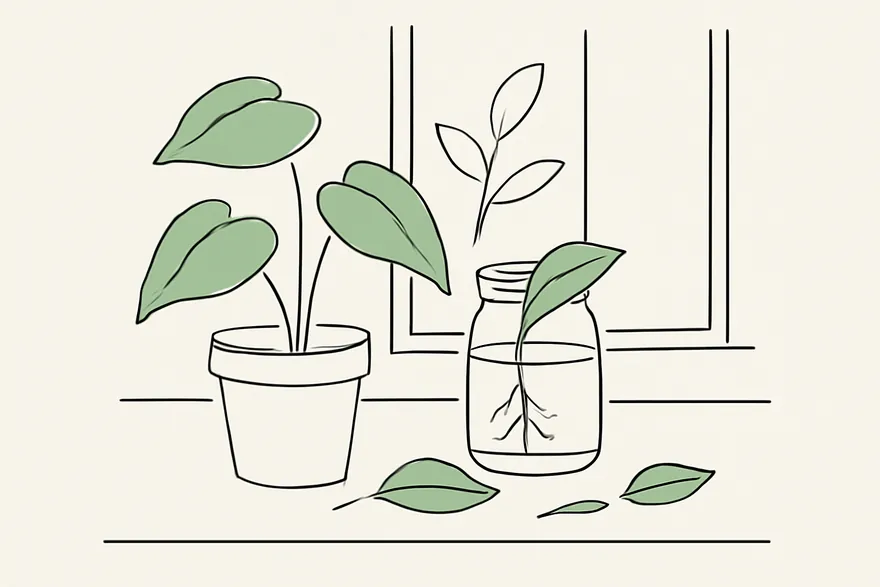
Why the Same Leaf Cutting Doesn't Work the Same Way Twice
A leaf cutting only grows into a new plant if it keeps hold of meristematic tissue — the cluster of undifferentiated cells that can divide into roots and shoots. Where that tissue sits inside the leaf is different in every genus, and that single fact explains why petiole cuttings are non-negotiable for African violets, why an echeveria leaf lives or dies by its "heel," and why Streptocarpus is one of the only houseplants where slicing the leaf into pieces beats propagating it whole. Treat all three the same way and results get inconsistent fast; match the cut to where the growth points actually live and success rates jump from "maybe" to "reliably."
African Violets: The Petiole Does the Regenerating
In Saintpaulia (now folded into Streptocarpus section Saintpaulia by botanists, though growers still call it a violet), the tissue that turns into baby plants forms almost entirely at the wounded base of the petiole. That's why the standard method every violet grower learns first is a petiole cutting, not a bare leaf laid on soil.
- Choose a healthy, mid-tier leaf — skip the oldest outer leaves and the tiny leaves still folded in the crown.
- Cut the petiole at an angle, leaving about 1 to 1.5 inches (2.5–4 cm) of stem attached to the leaf.
- Insert the cut end into moist perlite, a light soilless mix, or a glass of water, keeping the blade itself clear of the medium.
- Hold it at 70–75°F under bright, indirect light, with a loose plastic cover to keep humidity around 50–70%.
- Wait: roots usually show in 2–3 weeks, and plantlets appear at the petiole base 4–8 weeks in.
- Once plantlets carry 2–3 leaves of their own — typically 10–14 weeks from the start — separate them from the parent petiole and pot individually.
Done this way, standard (non-variegated) African violets root and produce plantlets 80–95% of the time under home conditions — one of the most forgiving leaf propagations in the hobby. Skip the petiole and just rest a leaf blade flat on soil with a few vein nicks, the trick that works for rex begonias, and violets respond far less reliably: often under 40%, taking two to three months if anything happens at all, because the blade tissue alone never builds up the auxin concentration that pools at a fresh petiole wound.
One honest caveat: variegated violet cultivars usually don't come true from any leaf cutting, petiole or otherwise. The white or cream pattern is typically a periclinal chimera — genetically different tissue layered through the leaf — and a leaf cutting regenerates from a single cell layer, so plantlets frequently revert to solid green. For a true copy of a variegated violet, propagate by suckers or division instead of leaves.
Echeveria: Take the Base or Get Nothing
Succulent leaf propagation runs on the opposite logic from violets. There's no petiole to speak of, but there is a "heel" — the thin ring of meristematic tissue exactly where the leaf attaches to the stem. That heel has to come away intact, or the leaf simply cannot produce a plantlet.
- Choose a plump, unblemished lower leaf and wiggle it gently side to side until it releases on its own — don't yank straight down or twist hard.
- Check the base immediately: a full, rounded heel means a clean pull; a leaf that snaps and leaves a pale sliver of tissue on the stem has left its meristem behind.
- Let the leaf callus for 1–2 days in a dry, shaded spot so the wound seals over.
- Lay it on top of — not buried in — well-draining succulent mix, and mist lightly every few days rather than watering the soil directly.
- Roots typically appear in 1–3 weeks, with a tiny rosette following at the base by week 3–6.
- Leave the original leaf attached until it's fully shriveled and grey — it's still feeding the new rosette — and let it detach on its own, usually by week 6–8.
Clean pulls with an intact heel succeed 60–80% of the time indoors. Snapped leaves that leave the heel on the stem rarely clear a 20% success rate, and a common, frustrating outcome is a leaf that grows roots but never grows a rosette — the "zombie leaf" every succulent forum has a thread about. If a leaf sprouts roots by week 3 with no sign of a rosette by week 8, the meristem wasn't there to begin with, and patience won't fix that. There's effectively no productive "leaf tip" cutting in echeveria: cut off just the tip or middle of a leaf and you'll get callus or rot, never a plantlet, because the growth point was never in that section.
Streptocarpus and Other Gesneriads: Cut the Leaf on Purpose
This is where the "leaf tip" idea actually earns its keep. Streptocarpus (Cape primrose) and several related gesneriads carry meristematic tissue in a line along the midrib and major veins rather than concentrated in one spot. In practice, that means a single leaf can be cut into several pieces and still produce plantlets from more than one of them — pointless in violets, impossible in echeveria, and routine here.
- Take a healthy, mature leaf and cut it into horizontal strips 2–3 inches (5–7 cm) wide, running across the leaf so each strip captures a section of the midrib vein.
- Insert each strip cut-side-down — the edge that was closer to the original petiole points down — into a moist, well-aerated mix such as perlite-vermiculite.
- Bury roughly a quarter to a third of each strip's height and firm it in place, leaving the rest upright.
- Cover for humidity and keep at 68–75°F under bright, indirect light.
- Expect callus formation over 2–4 weeks, with plantlets emerging along the buried vein edge starting around week 4–6.
An 8–10 inch leaf sliced into four or five strips can realistically yield a plantlet — sometimes two or three — per strip, multiplying total output well beyond what a single petiole cutting would give. Per-strip success rates commonly run 70–90% with steady humidity, though the first few weeks look inert while the cut edge calluses over; don't discard a strip before week 5 or 6. Sinningia (gloxinia) and some Primulina behave similarly, though a plain petiole cutting also works reasonably well on them.
Quick Comparison Before You Cut
- African violet: petiole cutting, 80–95% success, plantlets in 4–8 weeks, one plant per leaf — skip variegated cultivars if you want them to stay variegated.
- Echeveria: whole leaf with an intact heel, 60–80% success on a clean pull versus under 20% on a snapped leaf, rosette in 3–6 weeks, one plant per leaf at best.
- Streptocarpus: leaf strips across the midrib, 70–90% success per strip, plantlets in 4–6 weeks, multiple plants from a single leaf.
The through-line across all three: locate the meristem before you make the cut, not after. A petiole for violets, a heel for echeveria, a vein-bearing strip for Streptocarpus — matching the cut to the growth point is most of what separates a windowsill full of new plants from a saucer of quietly rotting leaves.
Quick comparison table for: Leaf Propagation Success Rates: Whole Leaf vs. Petiole vs. Leaf Tip Cuttings
| Section | What to check | How to use it |
|---|---|---|
| Why the Same Leaf Cutting Doesn't Work the Same Way Twice | Match the conditions and warning signs in this section | Use as a quick practical checklist |
| African Violets: The Petiole Does the Regenerating | Match the conditions and warning signs in this section | Use as a quick practical checklist |
| Echeveria: Take the Base or Get Nothing | Match the conditions and warning signs in this section | Use as a quick practical checklist |
| Streptocarpus and Other Gesneriads: Cut the Leaf on Purpose | Match the conditions and warning signs in this section | Use as a quick practical checklist |
Questions and answers
Why is a petiole cutting essential for African violets while whole-leaf methods are less reliable?
The article explains that in African violets, tissue that forms new growth is concentrated at the wounded base of the petiole, so a petiole cutting is the standard method. A bare leaf laid on the surface is much less consistent for violets, even with vein nicks, because that blade tissue does not build the same auxin concentration and roots and plantlets can be delayed or sparse.
How should an echeveria leaf be taken and handled for the best chance of plantlet formation?
Echeveria depends on an intact heel, the meristematic ring where the leaf joins the stem, so the leaf should be plucked with a full rounded heel and then allowed to callus for a day or two in a dry, shaded area. The leaf is then laid on top of well-draining succulent mix and misted lightly every few days. If the heel is torn off, chances drop and roots may form without a rosette.