Sprouting Avocado, Mango, and Citrus Seeds Indoors Without a Heat Mat
Test Viability Before You Plant Anything
Grocery-store avocado pits, mango seeds, and citrus pips are free planting material, but not all of them are alive by the time you get around to starting them. A quick check now saves weeks of watching a cup of water do nothing.
- Avocado: sink-or-float is a rough guide, since viable pits tend to be denser and sink, but the reliable test is a cut test. Slice a thin sliver off the pointed root end. Pale yellow-white flesh underneath means go ahead; grey, brown, or mushy tissue means compost it.
- Mango: press the seed gently between two fingers. A viable one feels firm and slightly springy, like a ripe plum pit. Spongy, cracked, or fermented-smelling seeds are done for. Mango seeds are recalcitrant, meaning they cannot be dried or stored the way a bean seed can, so anything more than about two weeks off the fruit has already lost ground.
- Citrus (orange, lemon, lime, grapefruit): the float test actually works here. Plump seeds that sink in a glass of water are usually good, and ones that float are often hollow. Freshness matters more than for the other two; a citrus seed left drying on a counter for a week can lose half its germination odds.
One honest caveat before you commit windowsill space: grocery-store fruit is very often a patented hybrid or a clone propagated by grafting, and even a seed that sprouts vigorously will not fruit true to the parent, and may not fruit for years, if ever, without grafting. Treat these as houseplant or rootstock projects, not a shortcut to homegrown Hass avocados.
Avocado: Warmth Beats a Fridge Stint
Unlike apple or peach pits, avocado seeds carry no cold-dormancy requirement. Refrigerating one accomplishes nothing and can invite rot in that humidity. What actually speeds things up is heat: avocado pits split and root fastest between 75 and 85°F. At a steady 65°F in an average living room, expect six to ten weeks before you see a taproot. Get the pit into the mid-70s to low 80s and that window drops to two to six weeks.
- Skip the heat mat and use warmth you already have: the top or back of a running refrigerator, where the compressor runs warm; a shelf above a water heater closet; or a spot near, not touching, a space heater or radiator with a folded towel as a buffer.
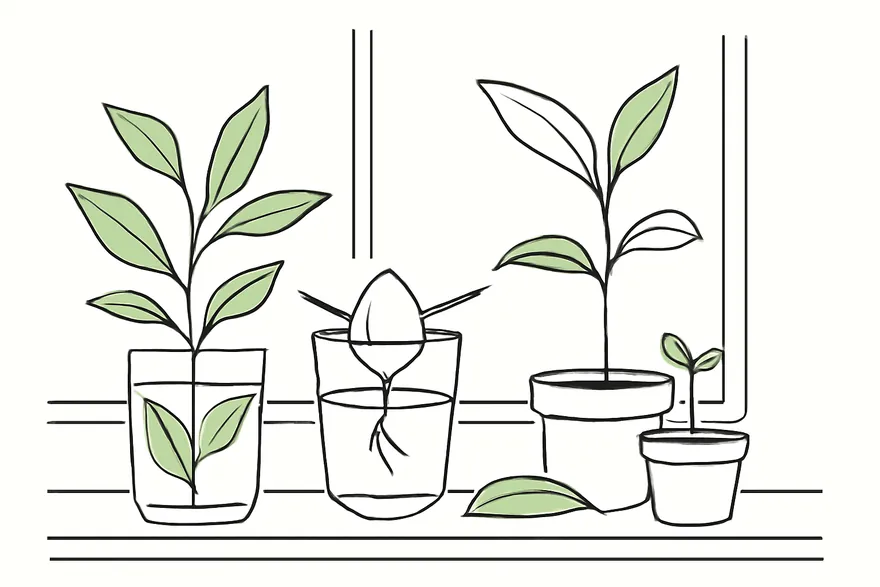
- Suspend the pit over a glass of water on three or four toothpicks pushed into the sides at a slight downward angle, wide end down, so the bottom third stays submerged.
- Change the water every four to five days. Stagnant water grows a bacterial film that can rot the base before roots form.
- Once the taproot is 2 to 3 inches long and a stem has sprouted, pot it in soil with the top half of the pit still exposed.
Mango: Strip the Husk, Bag It, Wait
The mango pit fished out of a smoothie mess is actually a husk, technically the endocarp, wrapped around the real seed. Left intact, that fibrous husk slows water uptake enough that germination takes three to four weeks. Cut it open along the seam with kitchen shears, carefully, since it is tough, and the kidney-bean-shaped seed inside will usually sprout in one to two weeks instead.
- Rinse off any clinging fruit fibers, since they mold quickly in a warm, damp setup.
- Wrap the bare seed in a damp, not dripping, paper towel, seal it loosely in a zip-top bag, and set it somewhere warm and dark: the top of the fridge, a cabinet above the oven, or an unheated oven with just the interior light left on if a thermometer confirms it holds 80 to 85°F rather than baking temperature.
- Check every two to three days. Roots often emerge from one end within a week.
- Many Southeast Asian and Caribbean varieties are polyembryonic and send up two to five separate seedlings from one seed. Let them grow until the first true leaves appear, then gently tease the root balls apart with the tip of a butter knife before potting each separately.
Citrus: The Cold-Stratification Myth
Plenty of seed-starting guides tell you to stratify citrus seeds in the fridge for weeks, the way you would apple pips. Skip that step. Citrus seeds evolved in subtropical and tropical climates and do not carry the physiological dormancy that a cold spell is meant to break. Chilling them does nothing useful and mostly risks drying them out or inviting mold. What actually helps is rehydration and steady heat.
- If the seed coat looks at all shriveled, soak it in warm, about 105 to 110°F, comfortably hot tap water for 24 hours, swapping the water once halfway through. This softens the coat and plumps the seed back up.
- Peel off the thin outer seed coat if it slips away easily after soaking. It is not required, but it can shave several days off sprouting.
- Wrap in a damp paper towel, bag it loosely, and hold it at 70 to 80°F. Most citrus seeds show a root tip within one to three weeks.
- Do not be alarmed if one seed produces two or three sprouts. Many citrus varieties are nucellar polyembryonic, meaning a single seed carries several genetically identical embryos alongside one true hybrid seedling. That is a citrus quirk, not a mistake on your part.
Household Substitutes for a Heat Mat, and When to Give Up
All three of these seeds want the same thing a heat mat provides, a steady 75 to 85°F, without needing the grow light a mat is often bundled with. A few no-cost substitutes worth trying:
- The top or back of a refrigerator, where the compressor runs.
- A shelf inside a cabinet that backs onto a water heater closet.
- Near, not on top of, a baseboard heater or radiator, with a towel between the container and the heat source.
- A cooler box holding a jar of hot, not boiling, water refreshed two or three times a day, a low-tech incubator.
- An oven with only the interior bulb on, confirmed with a thermometer to hold 80 to 85°F and no more.
A few warning signs are worth knowing before you write off a whole batch:
- A sour or ammonia-like smell from the bag or cup signals bacterial rot. Discard that seed rather than trying to rescue it.
- A little white fuzz on the paper towel is not automatically fatal. Rinse the seed, switch to a fresh dry towel, and loosen the bag for airflow. Fuzz growing on the seed itself, rather than just the towel, is the worse sign.
- If nothing happens after six weeks for avocado, or four weeks for mango and citrus, at consistently warm temperatures, the seed likely was not viable to begin with. Go back to the viability checks and start a fresh batch rather than waiting indefinitely.
Quick comparison table for: Sprouting Avocado, Mango, and Citrus Seeds Indoors Without a Heat Mat
| Section | What to check | How to use it |
|---|---|---|
| Test Viability Before You Plant Anything | Match the conditions and warning signs in this section | Use as a quick practical checklist |
| Avocado: Warmth Beats a Fridge Stint | Match the conditions and warning signs in this section | Use as a quick practical checklist |
| Mango: Strip the Husk, Bag It, Wait | Match the conditions and warning signs in this section | Use as a quick practical checklist |
| Citrus: The Cold-Stratification Myth | Match the conditions and warning signs in this section | Use as a quick practical checklist |
Questions and answers
How can I check whether these tropical seeds are viable before planting them indoors?
Use the source methods for each type. Avocado viability is best confirmed by a cut test: pale yellow-white tissue is acceptable, while gray, brown, or mushy tissue means discard it. Mango seeds should feel firm and slightly springy; spongy, cracked, or fermented-smelling seeds are not viable. Citrus works best with a float test, where plump sinking seeds are usually good and floating ones are often hollow.
What can I use instead of a heat mat, and what should I avoid during warm-starting?
The article suggests warm locations you already have: the top or back of a running refrigerator, a shelf near a water heater closet, or near a radiator/baseboard heater with a towel barrier. Avocado pits can be hung with the lower third in water and the water changed every few days. Mango and citrus can be wrapped in damp paper towel in a loose bag and held warm and dark. Watch for warning signs like sour or ammonia-like odor from the setup and stop seeds that begin rotting.