Hardening Off Rooted Cuttings: The Three-Week Humidity Taper Schedule
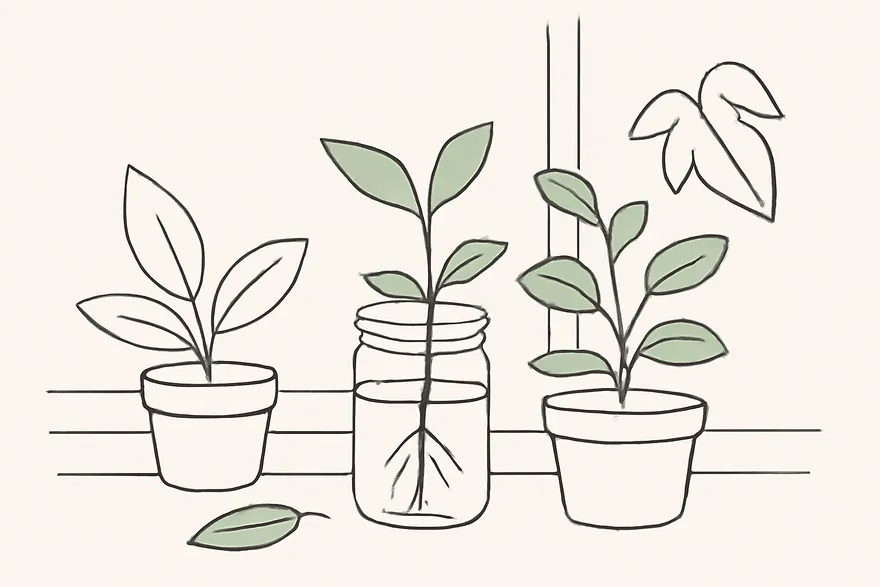
Why a Humidity Cliff Kills Freshly Rooted Cuttings
Roots on a two-week-old cutting are not miniature versions of mature roots. They have almost no root hairs, a thin cortex, and none of the suberized tissue that lets an established plant pull water efficiently from soil. Inside a propagation dome at 90-95% relative humidity, the cutting barely needs functioning roots at all — the leaves lose almost no water to transpiration, so the plant survives on whatever thin vascular connection it has managed to build.
Move that same cutting straight into open room air, and transpiration demand jumps five to ten times in an afternoon. The leaves start pulling water faster than the young roots can supply it, and you get the classic crash: crisping edges, sudden droop, sometimes total collapse within 24 hours, even though the roots themselves were perfectly healthy. Tapering humidity down over three weeks is not about toughening the plant up in some abstract sense — it is about giving the root system enough time to add lateral branching and absorptive area before you ask it to do a mature plant's job.
The Three-Week Schedule, Day by Day
This schedule assumes a clear humidity dome or bag over soft-stem cuttings — pothos, philodendron, tradescantia, coleus, ivy, and similar fast rooters. Track it with a small digital hygrometer placed inside the dome; guessing by feel is how most people either stall the process for six weeks or blow through it in four days.
Week One: Days 1–7, 95% down to 80%
- Days 1–3: Dome sealed, at most one small vent hole about a centimeter across. Humidity should read 90–95%. No adjustments yet — this is still active root initiation.
- Days 4–5: Prop the lid open 1–2 centimeters on one side with a matchstick or a bit of folded cardboard. Expect the reading to settle around 85%.
- Days 6–7: Widen the gap to 3–4 centimeters. Target is 80% by the end of day seven.
Week Two: Days 8–14, 80% down to 60%
- Days 8–10: Remove the lid entirely for one hour a day, then replace it. Humidity typically settles near 70% while the lid is off, then climbs back once it's on.
- Days 11–14: Stretch the lid-off period to roughly half the day. If your room humidity sits above 50%, leave the dome off overnight too and only replace it during the hottest, driest part of the afternoon.
Week Three: Days 15–21, 60% down to ambient
- Days 15–18: Lid off for all daylight hours. Only set it back on loosely if overnight temperatures drop and the room gets noticeably drier and colder at once, which stacks two stresses on the plant simultaneously.
- Days 19–21: No dome at all. The cutting now lives at whatever your room reads — usually 40–55% in a normal home. If it holds its leaves flat and turgid through day 21, the taper is done.
When to Expose the Roots
If a cutting rooted in water or a rockwool plug, moving it into soil is a separate stress from the humidity taper, and timing it matters. Transplant during week two, around days 10–14, once roots are at least an inch long with visible secondary branching and have shifted from glassy translucent to a duller white or tan color. Transplanting on day one or two — while the dome is still sealed and the roots are still glass-clear — adds mechanical stress on top of zero drought tolerance, and that combination is what causes silent root die-back that only shows up as leaf yellowing a week later.
Cuttings rooted directly in soil under a dome skip this step; there's no transplant shock to schedule, only the humidity taper itself.
Why Misting Backfires
The instinct when a leaf droops mid-taper is to reach for a spray bottle. Resist it. A few reasons this makes things worse rather than better:
- Misting spikes humidity toward 100% for ten to twenty minutes, then crashes back down hard as the droplets evaporate. That's a humidity swing, not a taper, and new roots handle a steady moderate humidity far better than a sawtooth pattern of spikes and crashes.
- Standing water on leaves in a low-airflow enclosed space is close to ideal conditions for gray mold (Botrytis) and bacterial leaf spot, particularly on fuzzy or thin-leaved cuttings like begonias or African violets.
- Misting treats the visible symptom — a limp leaf — not the actual cause, which is a root system that can't yet keep pace with transpiration. Spraying water on foliage does not make roots grow faster, and overspray that drips into the medium can waterlog the very root hairs you're trying to protect.
If wilting shows up between taper stages, the correct move is to pause: hold at the previous humidity step for another two to three days rather than advancing, and bottom-water if the medium itself has dried out. Done correctly, a taper schedule should need almost no misting at all.
Reading the Warning Signs
- Taper moving too fast: crisping leaf margins, new growth noticeably smaller than the leaves that rooted, wilting within an hour of the dome coming off. Go back one step and hold it for three to four extra days before trying again.
- Taper moving too slow: soft, translucent new growth, leggy stretch toward the light, any fuzz on stems or medium surface, or fungus gnats swarming the pot. Skip ahead a step and add airflow rather than waiting out the full week.
- Species change the timeline: succulents like echeveria and sedum barely need a dome and can taper in three to five days total; woody cuttings such as rosemary or hydrangea often need four to five weeks, not three. The schedule above is calibrated to fast-rooting soft-stem tropicals, not everything with roots.
- Keep a log: a daily hygrometer reading next to which vent step you're on is the single most useful thing you can do for the next batch of the same species — it tells you whether to compress or stretch the schedule before you've lost a single leaf finding out the hard way.
Quick comparison table for: Hardening Off Rooted Cuttings: The Three-Week Humidity Taper Schedule
| Section | What to check | How to use it |
|---|---|---|
| Why a Humidity Cliff Kills Freshly Rooted Cuttings | Match the conditions and warning signs in this section | Use as a quick practical checklist |
| The Three-Week Schedule, Day by Day | Match the conditions and warning signs in this section | Use as a quick practical checklist |
| Week One: Days 1–7, 95% down to 80% | Match the conditions and warning signs in this section | Use as a quick practical checklist |
| Week Two: Days 8–14, 80% down to 60% | Match the conditions and warning signs in this section | Use as a quick practical checklist |
Questions and answers
Why can a rooted cutting crash when moved from a dome to open air too quickly?
Freshly rooted cuttings have thin, weak-root structure and limited water uptake ability, while high humidity in the dome masks that weakness. Open-air air exposes the leaves to much higher water loss, and the roots cannot replace it fast enough, so leaves can crisp, droop, and even collapse even when roots looked healthy before.
Why is misting usually not the right response to a drooping cutting during hardening?
The guidance says misting makes humidity spike and then drop, creating swings instead of a steady decline. In enclosed low-airflow setups this also leaves wet foliage that supports gray mold and bacterial leaf spot. The safer response is to hold at the previous humidity level longer and use bottom-water only if the medium has dried.