Water Propagation Without Rot: Oxygen Levels and Container Design
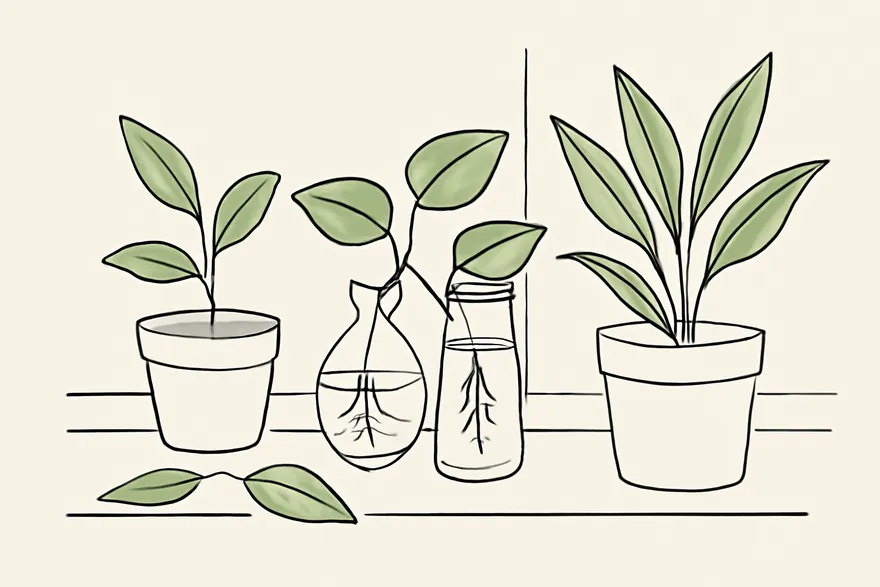
Why Cuttings Suffocate Before They Rot
"Rot" gets blamed on dirty water, weak genetics, or bad luck, but the real failure usually starts as an oxygen problem, not a bacterial one. A jar of room-temperature tap water holds roughly 7 to 9 milligrams of dissolved oxygen per liter. A cut stem still respiring, plus submerged leaf tissue slowly breaking down, draws that number down fast. Once dissolved oxygen near the cut surface drops under about 4 mg per liter, the tissue can no longer respire aerobically. Cells break down, and the anaerobic bacteria that thrive in low-oxygen water move in on the wound. What you are actually watching, when a cutting "rots," is oxygen starvation followed by opportunistic decay.
Container shape makes this worse than most people realize. A narrow-necked jar or bud vase filled almost to the top has very little surface area exposed to air relative to how much water it holds, sometimes a square inch of surface over four or five inches of still water. Oxygen near the stem never gets replenished from above, and any leaf node left submerged accelerates the drawdown by shedding organic matter as it decomposes.
The timeline is predictable once you know what to look for. A thin, slick biofilm shows up on the submerged stem within 48 to 72 hours in a warm room, above roughly 72°F (22°C). If oxygen keeps dropping, sulfate-reducing bacteria take over next, the source of the rotten-egg smell that shows up around day four or five in a badly designed jar. By the time you can smell it, the stem base is usually too soft to save.
The Warning Signs You're Losing the Cutting
Check the jar daily rather than waiting for a weekly change to reveal a problem, in order of how early each sign appears:
- Water turns cloudy or takes on a faint yellow-brown tint within two days of a change.
- A slimy film wipes off the submerged stem with a fingertip, usually the earliest visible sign, often a full day before any smell shows up.
- Swirling the jar releases a sulfur or "rotten egg" odor.
- The stem base turns dark brown to black and feels soft or mushy when pinched gently, instead of staying firm and pale.
- Submerged leaves turn translucent, then mushy, rather than simply wilting.
- Roots that do emerge are thin, brown, and stringy, and stop lengthening, instead of showing white, slightly thickened root hairs.
Catch it at the slime stage and you can usually save the cutting: rinse the stem, cut off the bottom half inch (about 1cm) into fresh, firm tissue, and move it into clean water in a better container. Once the base is black and mushy, that cutting is finished. Cut back further to check for firm white tissue underneath, or start over with a new cutting.
Building a Passive Aeration Rig with Bottle Caps and Stones
The fix is not fancier water, it is a container that keeps more surface area exposed to air, less water sitting stagnant, and a wound that is not fully submerged around the clock. Build the whole rig from a bottle cap and a handful of aquarium gravel in about ten minutes.
What you need
- A wide-mouth jar or deli container, 12 to 16 ounces, one jar per 3 to 5 cuttings
- A clean plastic cap from a 1 or 2-liter bottle, sized to rest inside or across the jar's rim
- A metal nail or a thick sewing needle, heated over a stove burner or lighter, held with pliers
- A handful of washed aquarium gravel or small river stones, rinsed until the runoff water is clear
- Room-temperature water
Assembly, step by step
- Heat the nail tip for about ten seconds, then melt three to five holes through the bottle cap, spaced evenly, each about 5 to 6mm wide, just snug enough to grip a stem without crushing it.
- Rinse the gravel thoroughly and add a 1 inch (2.5cm) layer to the bottom of the jar.
- Fill the jar with room-temperature water to about 1.5 inches (4cm) deep, enough to cover the stone layer, well short of the rim.
- Thread each cutting through a hole in the cap, leaves staying above the cap, cut end pointing down toward the stones.
- Rest the cap across the jar's rim, or let it float loosely, so the cuttings hang with only the bottom inch or so of stem in the water and the wound sitting mostly in the air gap between the cap and the water surface.
That air gap is doing the actual work. It behaves like a small passive lung: gas exchanges through the cap's holes and the loose fit around each stem, so oxygen keeps reaching the wound even though the stem tip stays wet. Keeping the water shallow over the stone bed also means less total water to deplete, so the ratio of air contact to water volume goes up without any extra effort.
Water Depth, Change Schedule, and the Stone Layer
Depth and timing matter almost as much as the rig itself, and both get skipped once the setup looks finished.
- Keep water depth at 1 to 1.5 inches (2.5 to 4cm), never filled to the rim. Shallow water oxygenates faster and holds less waste per cutting.
- Change the water completely every 3 to 4 days even if it still looks clear, and immediately if it clouds, slimes, or smells before then.
- Let chlorinated tap water sit uncovered for 24 hours so free chlorine can off-gas. If your utility uses chloramine instead (check your local water report), it will not dissipate the same way, so use dechlorinator or filtered water instead.
- Rinse the stone layer under running water at every second change, and swap the stones out entirely every few weeks once they pick up a slick coating.
The stones are not just a stand for the stems. They carry a thin biofilm of their own, mostly aerobic and nitrifying bacteria, competing with the anaerobic species responsible for that rotten-egg smell, the same logic an aquarium keeper relies on with bio-media, just scaled down to a jelly jar.
Which Cuttings Actually Need This
Not every cutting needs this rig, and it is worth being honest about that before melting holes in a bottle cap.
- Forgiving rooters, such as pothos, philodendron, tradescantia, and coleus, tolerate stagnant water for a week or two of neglect and often root fine in a plain jar with nothing more than a weekly water change.
- Woody and semi-woody stems, such as roses, hydrangea, fig, and lilac, are far less forgiving. Their thicker tissue rots from the inside before slime shows on the surface, and they benefit most from the aeration rig and the stricter change schedule.
None of this cures a cutting that is already rotting. Once the base is dark, soft, and smelling, the rig buys nothing, because the tissue damage is already done. What it does is shift the odds earlier, by giving healthy tissue enough oxygen to keep respiring while it forms callus and roots instead of breaking down. For anything worth rooting because it is expensive or slow to source, that shift in odds is worth ten minutes with a heated nail.
Quick comparison table for: Water Propagation Without Rot: Oxygen Levels and Container Design
| Section | What to check | How to use it |
|---|---|---|
| Why Cuttings Suffocate Before They Rot | Match the conditions and warning signs in this section | Use as a quick practical checklist |
| The Warning Signs You're Losing the Cutting | Match the conditions and warning signs in this section | Use as a quick practical checklist |
| Building a Passive Aeration Rig with Bottle Caps and Stones | Match the conditions and warning signs in this section | Use as a quick practical checklist |
| What you need | Match the conditions and warning signs in this section | Use as a quick practical checklist |
Questions and answers
Why do water cuttings rot if the water looks fine?
The process starts as oxygen starvation. A still jar with active stem respiration can pull dissolved oxygen down; when it falls below about 4 mg per liter near the cut, cells can no longer respire well and anaerobic bacteria take over. That is why clouding, slime, sulfur odor, and soft dark tissue usually appear after oxygen drops, not before.
How does the bottle-cap-and-stone rig reduce rot risk?
The rig keeps only the bottom part of the stem in shallow water while the cut end sits partly in an air gap, creating passive gas exchange through holes and around the stem. The recipe is a wide-mouth jar with a 2.5 to 4cm stone layer and about 1.5 inches of water, plus a bottle cap with three to five 5 to 6mm holes for stems, then daily checks and regular full water changes.